


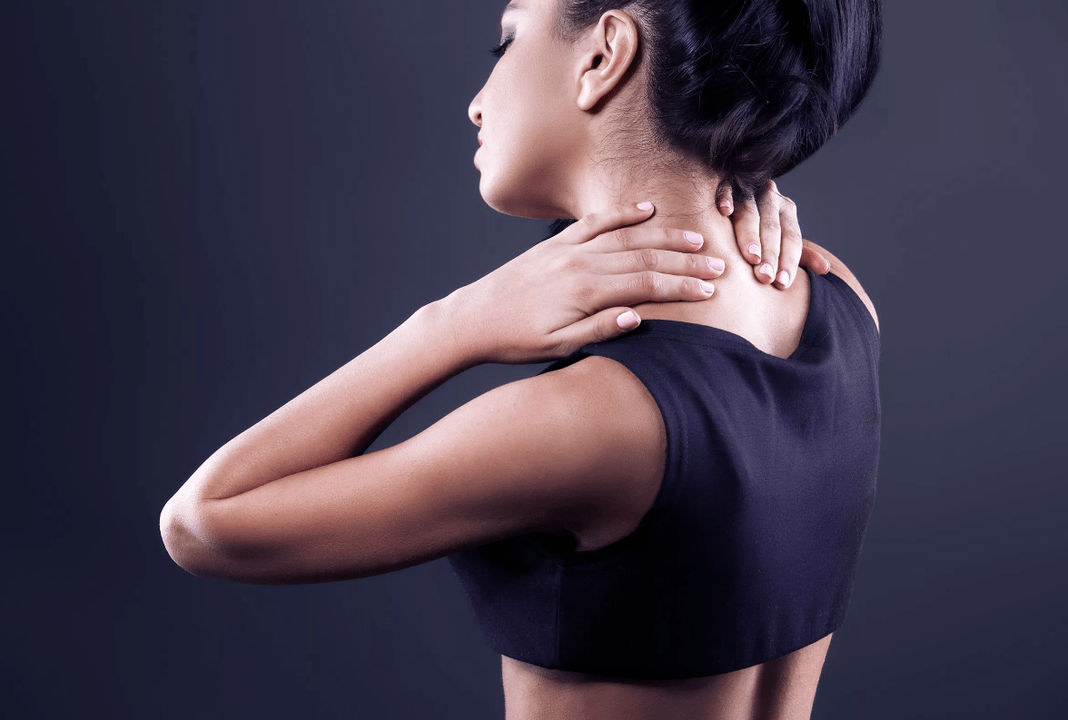
Do you experience unpleasant pain in the neck, which is accompanied by dizziness, general weakness and fatigue?All this should be a wake-up call for every person, because any of the listed symptoms may indicate the development of cervical osteochondrosis.
Such alarming symptoms should be treated with full responsibility, because in the absence of timely treatment, the pathology can cause more serious consequences, including intervertebral hernia.
What is osteochondrosis of the cervical spine?
Cervical osteochondrosis is a degenerative disease of the spine, during the development of which the structure of the connective tissue changes.
The disease is often disguised as a disorder of another type, but timely contact with a specialist allows for timely diagnosis and immediate treatment.
Degenerative changes in the tissues of the cervical spine are most often found in the medical history of people of mature (45-59) and elderly (60-74) age.
Despite this, it is worth noting: in modern society there is a rejuvenation of the disease, which is confirmed by the periodic diagnosis of cervical osteochondrosis in children and adolescents.
It is important that osteochondrosis can occur both in isolation and in combination with damage to other parts, in particular the thoracic, lumbar and sacral.
Causes of cervical osteochondrosis
Today it is impossible to name the exact causes of degenerative processes occurring in intervertebral discs.There is no confirmation that cervical osteochondrosis is an aging phenomenon.
Numerous studies conducted by scientists from different countries have found that osteochondrosis of the cervical spine has predominantly provoking factors.
Among the predisposing causes of the development of osteochondrosis of the neck are:
- low level of activity, inactivity and a predominantly sedentary lifestyle;
- types of work that involve a static load on the cervical spine;
- excess body weight, insufficient level of physical development;
- disruption of connective tissue development processes;
- old spinal injuries;
- spinal deformity, use of insufficiently comfortable pillows and mattresses for rest;
- genetic predisposition.
The vast majority of reasons are in one way or another related to the natural processes of aging of body systems, as well as the likely development of pathologies of bone and cartilage tissue.
What is the danger of cervical osteochondrosis?
A reduction in the level of mobility and limited flexibility of joints, loss of muscle elasticity and other signs of aging of the body are inevitable, natural processes that accompany a person in ontogenesis.
Annoying pain that occurs when moving much earlier than the natural period of aging often leads to loss of quality of life and even disability.
To determine how to treat cervical osteochondrosis, a professional consultation with your doctor is necessary.In the absence of professional, timely diagnosis and necessary treatment, the disease progresses, which can cause not just a deterioration in well-being, but also serious disruptions to the functioning of the nervous and vascular system.
Main signs and symptoms of cervical osteochondrosis
The structure of the human skeleton, the ability to walk upright and the impressive size of the head have led to the fact that some parts of the spine are the most vulnerable, in particular the cervical one.
Among the striking features of the structure of the cervical spine, it is worth highlighting the presence of predominantly small vertebrae and a relatively small number of muscles, and therefore it is in this area that ailment such as osteochondrosis most often occurs.
Pain is the most characteristic syndrome of spinal column disease.Depending on the affected area, it can concentrate:
- in the collarbone and/or shoulder;
- along the entire cervical spine;
- not the anterior surface of the sternum.
It is quite difficult to independently determine the primary signs of the disease, because in the vast majority of cases they are insignificant and very nonspecific:
- pain in the areaneckmainly in the evening;
- heaviness,pain in the back of the head;
- slight numbness,tingling in the shoulder, hands;
- crunch,clicking sound when turning the head.
The progression of the disease is accompanied by a number of already noticeable leading symptoms.
Vegetative-dystonic symptom
It is characterized by shooting pains in the neck, especially noticeable in the area just below the back of the head.
Pain often occurs when staying in the same position for a long time, for example, in the morning.
The neck muscles are tense, there are difficulties when moving the arm to the side, and stiffness in the movements of the fingers.
Due to compression of the vertebral arteries, neurological manifestations often occur:
- recurrent headaches;
- nausea;
- fainting.
Spinal symptom
Localization of the area is on the left behind the chest.
In the process of gradual disruption of the structure of the intervertebral discs, compression occurs and, as a result, pinching of the nerve roots occurs, which leads to narrowing of the arteries and veins, which in turn leads to the formation of radicular and ischemic syndrome.
Poor circulation causes:
- severe, migraine headaches;
- dizziness;
- visual impairment, tinnitus;
- disorders of autonomic functions.
In rare cases, a manifestation of cardinal syndrome can be observed, accompanied by compressive pain in the heart muscle, lack of air, and cardiac arrhythmia.
Degrees of development of cervical osteochondrosis and their characteristic symptoms
The process of development of the disease proceeds quite slowly, but at the same time it has 4 clearly visible stages:
- 1st degree cervical osteochondrosis – discomfort and minor pain during prolonged walking or static position.The beginning of the formation of compactions in the intervertebral discs;
- Osteochondrosis of the cervical spine, degree 2 – intense pain.In order to eliminate pain, manual therapy and appropriate medications are used;
- 3rd degree cervical osteochondrosis – the presence of severe lesions of the connective tissue of the affected area;
- Osteochondrosis of the cervical spine, grade 4, is the final stage of the development of the disease, characterized by damage to almost all parts of the spine.
The last stage of development of the disease requires surgical intervention, which entails a long recovery.
Diagnosis of the disease
If there are characteristic symptoms, in order to diagnose and treat osteochondrosis of the cervical spine, you must consult an orthopedic doctor or neurologist.
As part of the diagnostic measures, the specialist will determine mobility and pain in the neck area, as well as assess the degree of sensitivity, and identify other functional disorders.
Among the most effective diagnostic methods are:
- X-ray of the cervical spine, performed in various projections;
- CT (computed tomography);
- MRI (magnetic resonance imaging), if a hernia/protrusion is suspected.
In case of circulatory disorders, rheoencephalography and fundus examination may additionally be used.
Possible complications
Lack of timely treatment can lead to serious complications, including:
- bulging intervertebral discs(formation of hernia/protrusion);
- intervertebral disc rupture,accompanied by pinching of nerves and blood vessels, which can cause death;
- radiculopathy(damage to the nerve roots), the formation of osteophytes (spikes on the vertebral body) with the manifestation of numerous paresis and paralysis.
How to treat osteochondrosis of the cervical spine?
Treatment of cervical osteochondrosis is determined by a specialist and depends on the degree of development of the pathology, the form of its course and the characteristics of the clinical manifestation of the disease.
Today, the most effective methods of treating the disease are:
- treatment with conservative methods, including medicinal/non-medicinal;
- surgical intervention;
- complex combination of techniques.
Physiotherapy
Involves the impact of physical factors on the affected area.With an integrated approach and proper implementation of all procedures, improvements become clearly noticeable already in the second or third month of treatment.
Among the most popular areas of physiotherapy prescribed for the treatment of cervical osteochondrosis are:
- electrotherapy;
- shock wave therapy;
- magnetic therapy;
- ball therapy;
- laser therapy;
- vibration massage.
Neck massage for osteochondrosis
Massage should be performed carefully, without the use of force.Violation of massage technique can cause negative consequences.
The starting position for the massage is the “lying on your stomach” or “sitting with a straight back” position.
All existing massage techniques are based on techniques such as:
- stroking - influencing the surface layers of the skin.It is performed with the palms of the hands and fingertips downwards from the back of the head, to the level of the upper third of the back;
- squeezing - influencing the deep layers of skin in the upper third of the back.Performed with two fingers (thumb and index), carried across the neck;
- rubbing – the main goal is to warm up the skin and increase blood flow in the desired area;
- kneading – affects deep-lying tissues; it must be used with caution, since improper use can aggravate the situation.
Therapeutic gymnasticswith cervical osteochondrosis
There are certain exercises for the treatment of cervical osteochondrosis.The most effective of them include:
Self-extension
Starting position: sitting/standing with a straight back.
Execution order: while maintaining the starting position, try to lower your shoulders as low as possible, while stretching your head up.
Intensity of execution: at least 10 times (2-5 seconds each), at least 3 times a day.
Self-massage
Equipment: terry towel.
Starting position: sitting/standing, wrap a towel around your neck, and grab its ends with your hands.
Procedure: pull the ends of the towel one by one, gently kneading the neck muscles.
Important!During the exercise, you must ensure that the towel does not slip and rub your neck.
Gymnastics (flexion/extension, turns, bends)
Starting position: sitting/standing with a straight back.
Execution order: from the starting position, perform smooth flexion/extension, rotation or tilt of the head, first in one direction, then in the other.
Intensity of execution: 5-7 movements in one direction.
Drug treatment of cervical osteochondrosis
It is especially important during an exacerbation, since it is through the cervical spine that important blood vessels pass through, providing nutrition to the brain.
Tablets, injections, ointments, as well as other topical agents prescribed by the attending physician can be used as treatment.
Important!Self-medication with drugs of various groups is unacceptable and can lead to disability and death.
Nonsteroidal anti-inflammatory drugs
One of the most effective drugs, often used for osteochondrosis in the form of injections, but also available in the form of tablets, patches and ointments.
The key direction of action is to reduce pain, eliminate swelling and inflammatory processes.
Muscle relaxants
Provide effective reduction of muscle tension, which significantly reduces pain.
The recommended treatment period is from 2 to 4 weeks.
Anti-inflammatory, analgesic and warming ointments for cervical osteochondrosis
In order to increase efficiency, anti-inflammatory and painkillers contain steroid substances.
The effect of warming ointments is aimed at pain relief, as well as warming, which activates blood flow at the site of application of the drug.
Chondroprotectors
They are used to slow down degenerative processes and accelerate the regeneration of connective tissue.Has a cumulative effect.
Recommended dosage: from 2 to 6 months.
Features of nutrition in the treatment and prevention of cervical osteochondrosis
Proper nutrition is undoubtedly an important component of maintaining a healthy body.
In the context of the prevention or treatment of osteochondrosis of the cervical spine, diet is an auxiliary, but at the same time a very significant component.
The main goals of proper nutrition in the treatment or prevention of osteochondrosis are:
- eliminating the possibility of a deficiency of nutrients necessary for metabolic processes in the tissues of the intervertebral discs;
- maintaining optimal body weight;
- reducing the risk of developing vascular changes, preventing circulatory disorders.
Principles of diet
Nutrition for cervical osteochondrosis is based on the principles of rationality and functionality:
- Minimizing inhibitions - a healthy diet is varied, balanced and at the same time rich in all necessary substances.
- Compliance with the drinking regime is an important component in preventing tissue degradation of the intervertebral discs.
- Reducing salt consumption eliminates the possibility of increasing the load on blood vessels and ensures support of water and electrolyte balance.
- Limiting the consumption of starches and sugars in order to eliminate the possibility of metabolic disorders.
Prohibited and recommended foods
Nutrition in the treatment and prevention of osteochondrosis of the cervical spine requires the exclusion of products that clog the body, such as:
- alcohol, which disrupts the water-electrolyte balance and causes tissue dehydration;
- fatty meats and smoked meats that are difficult to digest;
- acidic, spicy dishes that increase inflammatory processes;
- semi-finished products that negatively affect digestion processes;
- sweets, sugar, which disrupt blood circulation.
The list of products recommended for consumption includes mainly easily digestible products of plant and animal origin, rich in protein, complex carbohydrates and fiber, including:
- chicken, rabbit, lean beef and pork;
- fish and seafood;
- dairy products, eggs;
- cereals of various types;
- whole wheat bread;
- fruits, vegetables, berries and herbs.
Preventive measures
The basis for the health of the human cervical spine is a strong back, the health of which is determined by:
- sufficient level of physical activity;
- maintaining optimal body weight;
- comfortable bed with anatomical pillows and high-quality mattress;
- maintaining correct posture;
- a combination of prolonged periods of sitting with periods of rest and physical exercise;
- maintaining proper nutrition.
In addition, it is recommended to avoid neck injuries and, of course, lifting excessive weights.